
Fence installation cost depends on far more than the fence itself. The biggest drivers are how long the fence is, how tall, what style you choose, your terrain, and the number of gates. As a benchmark, a typical residential fence job in the Raleigh area runs about $5,000–$8,000, though your project may land above or below that range.

What affects fence cost
No two yards are alike, so no two quotes are either. Here are the factors that move the number up or down:
- Length. Most of the industry talks in fence cost per linear foot, because materials and labor scale with how much fence you need. A longer run costs more in total, though the per-foot rate often improves at scale.
- Height. A 4 ft fence uses less material than a 6 ft one. Our privacy fence cost per foot guide breaks down the popular 6 ft option in detail if full privacy is your goal.
- Style. Fence materials tend to land fairly close in price, so the style you pick usually matters more than the material. A 3-rail wood fence can cost less than almost anything, while a wood privacy fence runs more than most — more on that below.
- Terrain. Flat, clear ground is fastest to work with. Slopes, tree roots, and obstructions all add labor.
- Gates. Every gate is a moving part with hardware, posts, and hinges. More gates — or wider drive gates — add to the total. See the options on our gates page.
- Old fence removal. Tearing out and hauling away an existing fence is its own line item.
- Permits and HOA approval. Many jurisdictions and neighborhoods require sign-off before work begins. Thomas Fence Co pulls the permit for you unless you’d rather handle it yourself, and we help prepare HOA paperwork, though the homeowner does the actual submittal. Install takes about two weeks from HOA and permit approval.
For a side-by-side look at your choices, our compare fencing materials and fence types and options pages are good starting points.
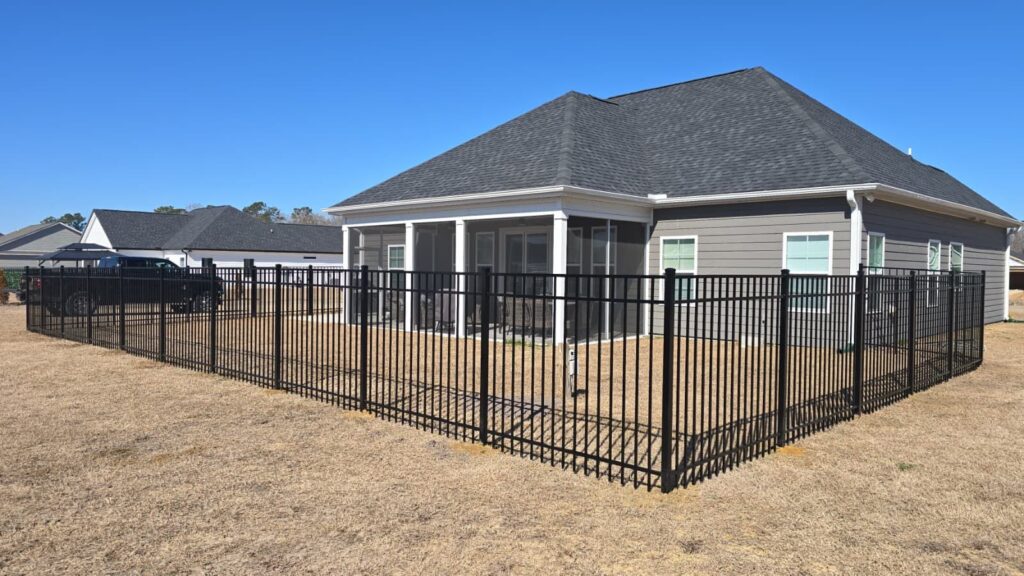
Wood vs vinyl vs aluminum vs chain link: why style matters more than material
Rather than quote dollar figures that change by region and project, it helps to start with a simple idea: fence materials tend to land fairly close in price, so the style you choose usually drives the cost more than the material does. The notes below are relative and style-based. For exact lifespans, always check the manufacturer’s warranty on the specific product.
| Material | Style examples / relative cost notes | Best for |
|---|---|---|
| Chain link | Long the budget pick; rising steel costs are pushing it toward the higher end | Security, pets, marking boundaries |
| Wood | Wide range by style — a 3-rail wood fence can cost less than almost anything, while a wood privacy fence runs more than most | Classic look, from open rail to full privacy |
| Vinyl | Fairly close to other materials; style and height drive the price | Privacy with minimal upkeep |
| Aluminum / iron | Fairly close on material; ornamental styles drive the cost | Decorative, pool, and ornamental runs |
The biggest cost lever here isn’t the material itself — it’s the style. A 3-rail wood fence, for example, can cost less than almost anything, while a wood privacy fence runs more than most other options. Chain link was long the most economical way to mark a boundary, but rising steel costs are pushing it toward the higher end. Maintenance differs too: wood needs periodic staining or sealing to look its best, while vinyl resists rot and asks little of you afterward.
We install quality lines from Ironwood, Stephens, and Catalyst, and products carry a materials warranty ranging from 10 years up to lifetime depending on the item. You can see the full range on our services page.
Why the same fence costs differently in MD, NC and SC
An identical fence design can carry a different price in Maryland, North Carolina, and South Carolina. Local labor rates, material availability, permitting requirements, and soil conditions all vary from market to market.
In Maryland, we serve communities across St. Mary’s, Charles, and Calvert counties — see our Maryland locations hub for the full list. Local permit and HOA rules differ by county, which can affect both cost and timeline. In Maryland, permits usually take about 4–6 weeks. Thomas Fence Co pulls the permit for you unless you’d rather handle it yourself, and we help prepare HOA paperwork, though the homeowner does the actual submittal.
Around Raleigh, a typical job lands in the $5,000–$8,000 range noted earlier, though your result depends on the same factors — length, height, style, and gates. See our Raleigh, Wake County page for local service details.
On the South Carolina coast near Myrtle Beach, sandy coastal soil and salt air shape both material choice and installation. Loose, sandy ground can call for extra care when setting posts, and corrosion-resistant materials are worth considering near the shore.
Hidden costs
The sticker number usually isn’t the whole story. Watch for these items when you plan your budget:
- Old fence removal. If there’s an existing fence, removal and disposal add labor.
- Property surveys. A survey isn’t required, but we always recommend one. If your property lines aren’t clearly marked, it confirms exactly where the fence can legally go.
- HOA fees. Some communities charge for application or architectural review. These vary by community and are set by the HOA.
- Difficult soil. Rocky ground in parts of Maryland and the Carolina Piedmont slows digging; sandy coastal soil in South Carolina may need extra post support. Both can add labor compared with clean, flat dirt.
Before every dig we call NC811 / 811 to locate underground utilities, so lines are marked and protected — a safety step, not an added surprise.
How to compare quotes
Fence quotes are only comparable when they cover the same scope. When you collect bids, line them up on these points:
- Material and grade. Confirm the brand, style, and height so you’re comparing like for like.
- Linear footage and gates. Make sure each quote reflects the same length and the same number and size of gates.
- What’s included. Does the price cover old fence removal, permit handling, HOA paperwork, and cleanup? Thomas Fence Co pulls the permit unless you prefer to do it yourself, assists with HOA paperwork while the homeowner handles the submittal, and always recommends a survey even though one isn’t required.
- Warranties. Ask about both the workmanship warranty and the materials warranty. Ours run 1–5 years on workmanship and 10 years to lifetime on materials, depending on the product.
- Track record. A company that stands behind its work matters. Thomas Fence Co has installed fences since 1976 — 40-plus years — with a 35-person in-house team, MHIC 135844, and state and local contractor licenses. We’ve been voted a Nextdoor Neighborhood Favorite from 2023 through 2025.
We offer free estimates on site, by phone, or online, and respond the same day.
Financing options
A fence is an investment, and you don’t have to pay for all of it up front. Thomas Fence Co offers financing through Wells Fargo, including 0% for 12 months, subject to credit approval. Details and the application are on our financing page.
Frequently asked questions
How is fence cost calculated?
Fence cost is driven mainly by length (often measured per linear foot), height, material, your terrain, and the number of gates. Add-ons like old fence removal, permits, and HOA approval factor in too. The clearest way to get your number is a free on-site estimate, where we measure the job and account for every variable.
What is the cheapest fence?
There’s no single cheapest material — fence materials tend to land fairly close in price, so the style you choose matters more than the material. A 3-rail wood fence can cost less than almost anything, while a wood privacy fence runs more than most options. Chain link was long the budget pick, but rising steel costs are pushing it toward the higher end. The clearest way to find your lowest-cost option is a free on-site estimate.
Does a fence add value to a home?
A well-built fence can add privacy, security, and curb appeal, which many buyers value. The impact on resale depends on your market, the material, and the quality of the installation, so results vary by home and neighborhood.
Do I need a survey before installing a fence?
A survey isn’t required, but we always recommend one. If your property lines aren’t clearly marked, a survey confirms exactly where the fence can legally be placed and helps avoid disputes with neighbors..
Can I finance a fence?
Yes. Thomas Fence Co offers financing through Wells Fargo, including 0% for 12 months, subject to credit approval. You can review the terms and apply on our financing page.
Ready for a real number instead of a range? Request a free estimate from Thomas Fence Co — on site, by phone, or online — and we’ll respond the same day with a quote built around your yard, your style, and your budget.
Permits and HOA rules can add time to a project, so read getting HOA approval for a new fence before you set a start date. If an old fence is part of the job, see when to repair a fence and when to replace it.
Thomas Fence Co has offices in three states. Find the one nearest you on Google for directions, hours and reviews: Bushwood, MD, Fuquay-Varina, NC or Myrtle Beach, SC.