
In most cases, yes. A standard homeowners policy usually treats a fence as an “other structure,” and it pays for damage from covered causes such as wind, hail or a tree that falls in a storm. Flood damage is the big exception, because standard homeowners policies do not cover flooding. You also pay your deductible first. Along the coast, that is often a separate named storm or wind deductible that can be much larger than your normal one.
Every policy is different, so check your policy: your declarations page and your agent have the final word. This guide is general information, not legal or insurance advice. This guide explains how coverage usually works in North Carolina and South Carolina, and what to do in the first few days after a storm.
Key takeaways
- In most cases, a standard homeowners policy treats a fence as an “other structure” and pays for damage from covered causes such as wind, hail or a tree that falls in a storm.
- Flood damage is the big exception, because standard homeowners policies do not cover flooding.
- You pay your deductible first. Along the coast, that is often a separate named storm or wind deductible that can be much larger than your normal one.
- Insurance is for sudden damage. Rot, termites, old age, or a fence that was already leaning or broken are usually not covered.
- Get a written repair estimate first, then check your policy and ask your agent which deductible applies before you decide to file a claim.
How a Homeowners Policy Usually Treats a Fence
Most homeowners policies split the property into parts. The house itself is the dwelling coverage (often called Coverage A). Detached things on the lot, such as a shed, a detached garage or a fence, fall under “other structures” (often called Coverage B).
- The limit is usually a share of your dwelling coverage. Many policies set other structures coverage at 10% of the dwelling amount. If your home is insured for $300,000, that is about $30,000 for everything detached on the lot combined (Texas Department of Insurance consumer guide; IRMI definition of other structures).
- A fence attached to the house can be treated differently. Some policies and court decisions count a fence that connects to the house as part of the dwelling (Insurance Journal, “Is a Fence a Fence?”). Ask your agent which part of the policy your fence falls under.
- Payment may be for the fence’s current value, not a new one. Many policies pay fences at actual cash value, which means an older fence gets a payment reduced for wear and age (Texas Department of Insurance). Check whether your policy says actual cash value or replacement cost.
What Is Usually Covered, and What Usually Is Not
| Cause of damage | Usually covered by homeowners insurance? |
|---|---|
| High wind or hail | Usually yes, if wind is not excluded from your policy |
| A tree that falls in a storm | Usually yes |
| A car that hits the fence | Usually yes, often through the driver’s auto policy first |
| Flooding or storm surge | No, standard policies exclude flood. Flood insurance is a separate policy |
| Rot, termites or old age | No, wear and lack of upkeep are not covered |
| A fence that was already leaning or broken | Often no, or only the part the storm damaged |
Insurance is for sudden damage. A storm that snaps posts is a claim. A fence that slowly rotted at the ground line and finally fell over in a breeze is usually not.
Named Storm and Wind Deductibles in North Carolina
In parts of North Carolina, especially the beach and coastal areas, a policy can carry a separate deductible for named storms or for wind and hail. The NC Department of Insurance (NC DOI) explains that a named storm deductible is usually a percentage of your dwelling coverage (or personal property coverage), and its own example shows a 2% named storm deductible on a $300,000 home works out to $6,000 (NC DOI, Windstorm and Hail).
NC DOI also notes that in some coastal areas wind and hail coverage is left out of the main policy and bought separately, often through the North Carolina Insurance Underwriting Association, also known as the Coastal Property Insurance Pool. That separate policy has its own deductible.
What this means for a fence: if the only damage from a hurricane is a few sections of fence, the repair bill may be smaller than the named storm deductible. In that case a claim may not pay anything, and it can make sense to pay for the repair yourself. Your agent can tell you which deductible would apply.
Hurricane and Wind Deductibles in South Carolina
South Carolina rules require insurers to tell you in writing if your policy has a separate hurricane, named storm or wind and hail deductible. The policy and the declarations page must carry a warning that it “may result in high out-of-pocket expenses,” along with an example for a $100,000 policy and a clear explanation of what triggers the deductible (S.C. Code Regs. 69-56).
If you live in Myrtle Beach, North Myrtle Beach, Surfside Beach or elsewhere along the Grand Strand, look for that warning on your declarations page before storm season. The Insurance Information Institute notes that percentage deductibles often run from 1% to 5% of the home’s insured value, and can be higher in some high-risk coastal areas (Triple-I, hurricane and windstorm deductibles).
What to Do After a Storm Damages Your Fence
The SC Department of Insurance and NC DOI give similar advice after a storm. Applied to a fence, it looks like this:
- Stay safe first. Stay clear of downed power lines and do not try to lift a tree off a fence yourself.
- Photograph everything before you move anything. Take wide shots of the whole fence line and close-ups of broken posts, panels, gates and hardware. Get the tree or debris in the photo if one caused the damage (SC DOI post-storm guidance).
- Prevent more damage. Most policies expect you to take reasonable steps to protect the property, such as closing off a gap so a pet cannot get out. Keep receipts for any temporary fixes, because they may be reimbursed on a covered claim.
- Call your agent or insurer soon. Ask which deductible applies, whether you need repair estimates, and when an adjuster will look at the damage. Write down the name of everyone you speak with (NC DOI claims and adjuster information).
- Get a written repair estimate. An itemized estimate that lists the materials, the number of posts and sections, and any gates helps you compare the repair cost with your deductible, and gives the adjuster something concrete to work from.
Repair or Replace After a Storm?
Storm damage often hits only a few sections. If the posts are sound, replacing broken panels or pickets can be enough. If many posts are snapped or loose, or the fence was near the end of its life anyway, replacing the run may make more sense. Our guide to fence repair vs replacement walks through how to decide, and how long a fence lasts by material can help you judge how many years your fence had left.
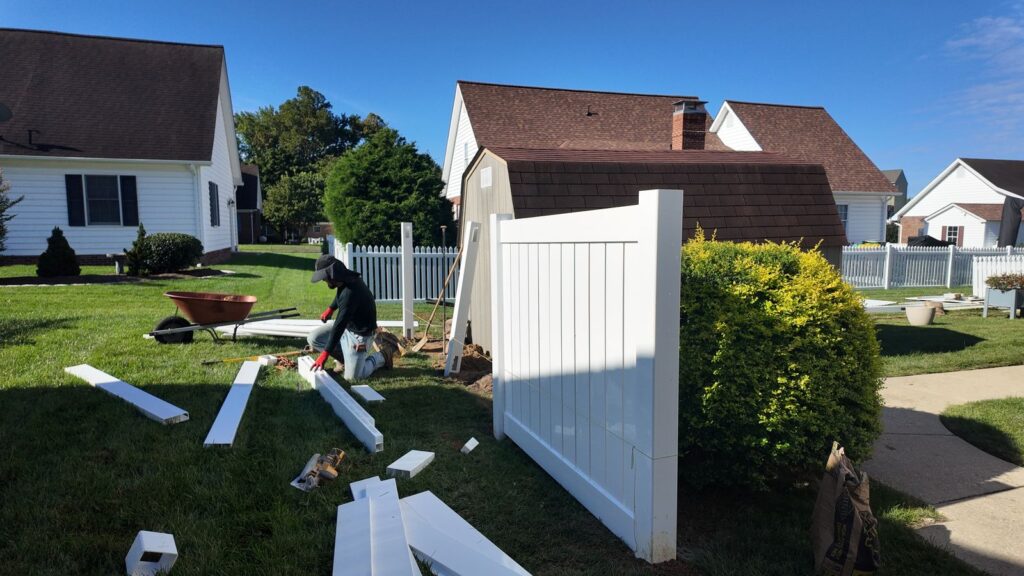
If you are replacing a fence near the coast, read up on hurricane-resistant fencing and the best fence materials for salt air before you pick a material.
Getting a Free Estimate in the Raleigh and Myrtle Beach Areas
Thomas Fence Co is a family-run fence company with more than 40 years in the business. Our Fuquay-Varina office at 1206 N Broad St, Fuquay-Varina, NC 27526, (919) 725-7746, serves the Raleigh and Wake County area, and our Myrtle Beach office at 1355 Dividend Loop, Myrtle Beach, SC 29577, (910) 558-0956, serves Horry County and nearby Brunswick County, NC. Estimates are free, and financing is available on approved credit.
We can’t tell you what your policy covers. Only your policy and your agent can. What we can do is look at the damage and give you a written estimate, so you have real numbers to compare with your deductible.
Frequently Asked Questions
Does homeowners insurance cover a fence blown down by wind?
Usually, yes. Most homeowners policies cover fences under other structures coverage for sudden damage from wind, hail or a fallen tree, as long as wind is not excluded from your policy. You pay your deductible first, and in coastal NC and SC that may be a separate named storm or wind deductible.
Does insurance cover a fence damaged by flooding?
No. Standard homeowners policies do not cover flood or storm surge damage. Flood coverage comes from a separate flood insurance policy, so check that policy’s terms for fences and other structures.
Is it worth filing a claim for a damaged fence?
It depends on your deductible. If the repair costs less than your deductible, the claim will not pay anything. Get a written repair estimate first, then check your policy and ask your agent which deductible applies before you decide.
Will insurance pay for a brand-new fence?
Not always. Many policies pay fences at actual cash value, which takes age and wear into account, so an older fence may get less than the cost of a new one. Policies with replacement cost coverage pay closer to the full cost of rebuilding.
Thomas Fence Co has offices in three states. Find the one nearest you on Google for directions, hours and reviews: Bushwood, MD, Fuquay-Varina, NC or Myrtle Beach, SC.