
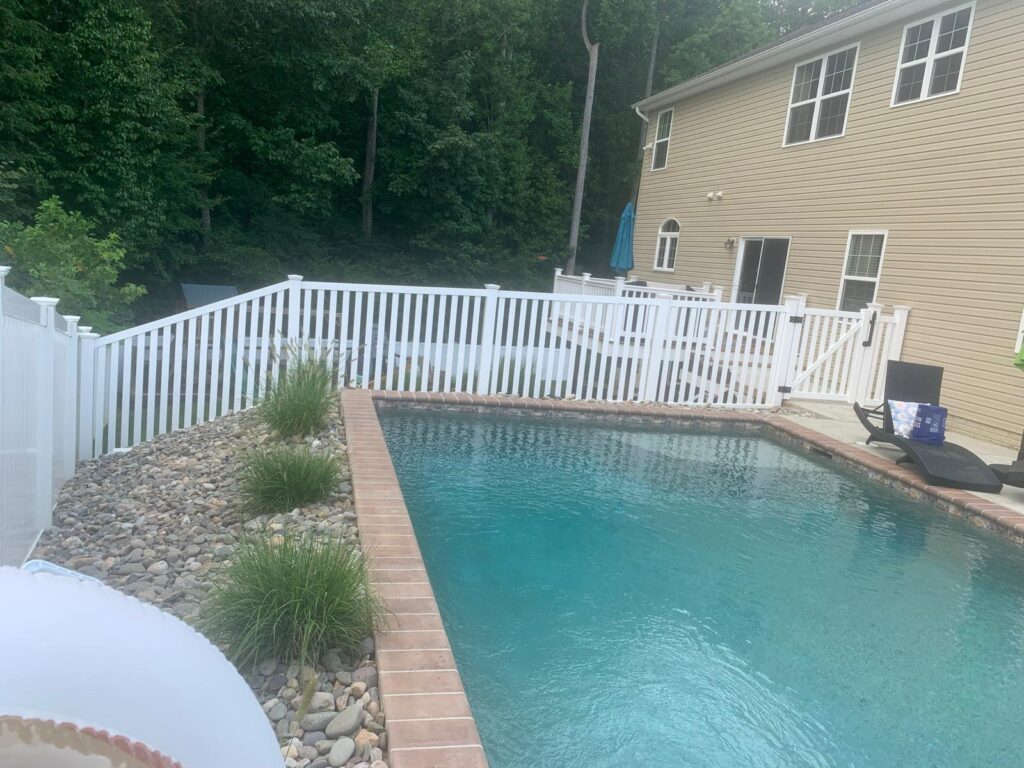
In Maryland, North Carolina and South Carolina, private pool barriers are generally based on the International Swimming Pool and Spa Code (ISPSC) or a similar pool-barrier appendix in the residential building code: a minimum 48-inch-tall barrier, narrow gaps and openings, and a self-closing, self-latching gate that swings away from the pool. Exact rules vary by state and county, so always confirm current requirements with your local building department before you install or alter a fence.
Why Do Pool Barrier Codes Exist?
Drowning is a leading cause of death for young children, and a barrier that fully separates the pool from the house and yard measurably reduces that risk. The Centers for Disease Control and Prevention has reported that a four-sided isolation fence, one that separates the pool area from both the house and the yard, reduces a child’s drowning risk significantly compared with a three-sided fence that uses the house as one side of the barrier (CDC, Risk Factors for Drowning).
That’s the safety logic behind nearly every residential pool barrier code in the country: a continuous, climb-resistant barrier with a gate that closes and locks itself, so a young child can’t wander into the pool area unsupervised.
What Are the Common Pool Fence Requirements?
Maryland, North Carolina and South Carolina don’t each write their own pool-barrier rules from scratch. All three ultimately trace back to the same model code language. The International Swimming Pool and Spa Code (ISPSC) Section 305, “Barrier Requirements,” or the closely related swimming-pool appendix in the International Residential Code (IRC). Here’s what that model language generally requires. Treat the specific numbers below as a starting point, not a substitute for your local building department’s current adopted edition.
- Height. The top of the barrier must be at least 48 inches (4 feet) above grade, measured on the side facing away from the pool, around the entire perimeter (ICC ISPSC 2021, §305.2.1).
- Ground clearance. The gap between the bottom of the barrier and the ground generally can’t exceed 2 inches over a non-solid surface like grass or gravel, or 4 inches over a solid surface like a concrete patio (ICC ISPSC 2021, §305.2.1).
- Openings. No gap in the barrier may be large enough to pass a 4-inch-diameter sphere (ICC ISPSC 2021, §305.2.2).
- Climbability. If the barrier has horizontal rails spaced less than 45 inches apart, those rails must be on the pool side of the fence so they can’t be used as a ladder from the outside; vertical member spacing is generally capped at 1¾ inches in that configuration (ICC ISPSC 2021, §305.2.5 to 305.2.6).
- Self-closing, self-latching gates. Pedestrian gates must open outward, away from the pool, close on their own, and latch on their own (ICC ISPSC 2021, §305.3).
- Latch release height. If the gate’s release mechanism sits lower than 54 inches above grade, it generally has to be mounted on the pool side of the gate, at least 3 inches below the top of the gate, with no openings larger than ½ inch within 18 inches of the release (ICC ISPSC 2021, §305.3.3).
- House wall as part of the barrier. If a wall of the home forms part of the pool enclosure and a door or window gives direct access to the pool area, code generally requires an audible alarm on that door/window, a listed power safety cover on the pool, or another approved safeguard of equal protection (ICC ISPSC 2021, §305.4).
Because these are model-code provisions, the exact section numbers, clearance figures and effective dates can differ once a state or county adopts and amends them, which is exactly what happens in Maryland, North Carolina and South Carolina.
What Are Maryland’s Pool Fence Requirements?
Maryland adopts the IRC statewide through the Maryland Building Performance Standards (MBPS), administered by the Maryland Department of Labor (Maryland Dept. of Labor, Building Codes). Swimming pool and spa barriers specifically are addressed by a separate regulation, COMAR 09.12.56, the “Maryland Swimming Pool and Spa Standards,” which incorporates the ISPSC by reference and applies to private residential pools for which a building permit application is received on or after December 31, 2023 (COMAR 09.12.56.02, Scope; COMAR 09.12.56.03, Incorporation by Reference).
One important distinction: a different Maryland regulation, COMAR 10.17.01.21, sets taller barrier heights (up to 72 inches): but that rule applies to public and semipublic pools, such as community or HOA pools, not to a private backyard pool. Don’t confuse the two when checking requirements for a residential fence.
For Southern Maryland specifically:
- St. Mary’s County requires a building permit and a code-compliant barrier for in-ground pools, consistent with the state-adopted standard. The county’s exact currently-posted permit documents should be confirmed directly, since code editions have been updated recently.
- Charles County requires a building permit for fences over 7 feet tall and for any fence in the Chesapeake Bay Critical Area; no Charles County page with pool-fence-specific numbers different from the state standard was found during research. Confirm current rules with the county.
- Calvert County requires a signed Pool Fence Affidavit confirming a code-compliant barrier before final inspection (Calvert County, Pool, Residential).
Across all three counties, confirm the specific edition of the code currently enforced, and the exact clearance and latch-height figures, with your local building/permit office before finalizing a design, local permit paperwork doesn’t always update on the same schedule as the state regulation.
What Are North Carolina’s Pool Fence Height Requirements?
North Carolina adopts its own version of the IRC, the North Carolina Residential Code (NCRC), with a dedicated swimming-pool barrier appendix. As of this writing, the 2018 NCRC (Appendix V, “Swimming Pools, Spas and Hot Tubs”) remains the currently effective statewide standard; a newer 2024 edition with an updated pool appendix has been adopted on paper but its statewide effective date has been delayed pending further state action (NC Office of State Fire Marshal, Codes, Current and Past). Confirm which edition applies to your project before design.

In the Raleigh/Wake County area, where Thomas Fence Co’s North Carolina office is located:
- The City of Raleigh publishes detailed pool-barrier guidance matching the model-code pattern: minimum 48-inch barrier height, limited ground clearance, the 4-inch sphere test for openings, and self-closing, self-latching gates that swing outward (City of Raleigh, “ABCs of Installing a Pool or Spa”. This city page returned an automated-access error during our link check; verify the current content directly in a browser before citing specific numbers from it).
- Wake County requires pools to be enclosed by a barrier that complies with Appendix V of the North Carolina Residential Code, and charges a permit fee for in-ground pools (Wake County, Install a Swimming Pool or Hot Tub).
- Fuquay-Varina has no dedicated published page on pool barrier specifics; the town’s permitting pages confirm pools need a permit as an accessory structure but defer to the state/county code for barrier details. Confirm with the Town of Fuquay-Varina’s inspections staff before starting a project.
No North Carolina-specific deviation from the standard 48-inch minimum height or self-latching gate requirement was found in official sources; treat 48 inches as the baseline and confirm the exact ground-clearance figure (some sources show 2 inches, others 4 inches depending on surface) with your local building department.
What Are South Carolina’s Pool Fence Requirements?
South Carolina mandates the IRC statewide (currently the 2021 edition, with a 2024 edition scheduled to take effect January 1, 2027), but handles the ISPSC differently than Maryland or North Carolina: the South Carolina Building Codes Council classifies the ISPSC as a “permissive code,” meaning a county or city must separately adopt it by local ordinance before it’s enforceable there (SC LLR Building Codes Council, Code Adoption). There is no South Carolina statute specifically mandating residential pool fencing. The requirement comes through whichever code the local jurisdiction has adopted.
In the Myrtle Beach area, where Thomas Fence Co’s South Carolina office is located:
- Horry County has formally adopted the 2021 ISPSC, Section 305, for residential pools, and requires a signed Pool Fence Affidavit confirming the barrier meets the code before final inspection (the same 48-inch minimum height, ground-clearance limits, 4-inch sphere rule, and self-closing, self-latching outward-swinging gate described above (Horry County, Pool Fence Affidavit) 2021 ISPSC; Horry County, When to Get a Building Permit).
- City of Myrtle Beach requires both a pool permit and a separate fence permit, and the city will not release the pool permit until the fence/enclosure application is approved (City of Myrtle Beach, Forms and Applications). The city’s specific numeric barrier requirements should be confirmed directly with Myrtle Beach Construction Services, since the detailed permit forms weren’t accessible during our research.
No South Carolina-specific deviation from the 48-inch height or self-latching gate standard was found for Horry County; always confirm whether your specific municipality (Myrtle Beach, North Myrtle Beach, or unincorporated Horry County) has layered any additional local rules on top of the base code.
What’s the Best Material for a Pool Fence?
Several fence materials can meet pool-barrier code as long as the height, spacing and gate hardware meet the applicable requirements:
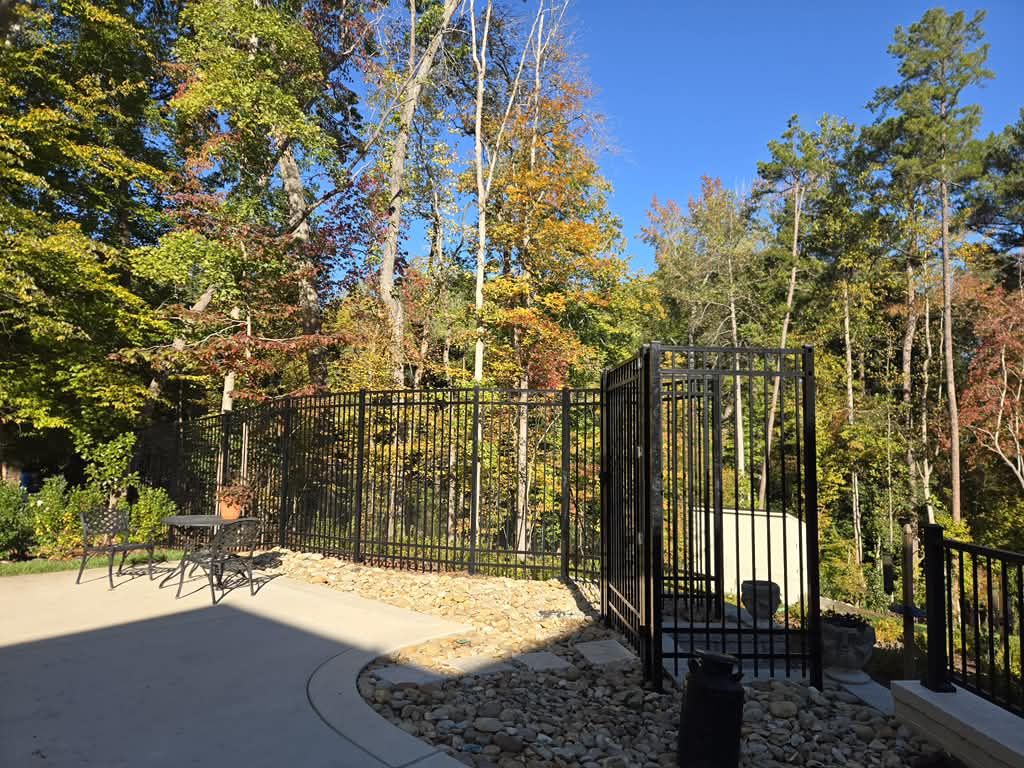
- Aluminum ornamental fencing is a common pool-fence choice because its vertical picket spacing can be built to meet the 4-inch sphere rule while keeping sightlines open around the pool. Thomas Fence Co is a dealer for Jerith aluminum fencing. See our Jerith aluminum fence page for details.
- Vinyl fencing can also meet pool-barrier requirements and offers more privacy than an open aluminum or ornamental style, at the cost of visibility into the pool area for supervising adults.
- Whatever material you choose, pay attention to climbability: avoid horizontal rails or decorative elements spaced in a way that creates a foothold from outside the barrier, and keep patio furniture, planters, grills and other climbable objects away from the fence line.
Pool Fence Inspection Checklist
Before you request a final inspection, walk the barrier and check:
- Barrier height is at least 48 inches above grade on the side facing away from the pool, around the full perimeter.
- Gap under the barrier doesn’t exceed the limit for your surface type (commonly 2 inches over grass/gravel, 4 inches over a solid surface).
- No opening in the fence passes a 4-inch-diameter sphere.
- Vertical member spacing meets the 1¾-inch limit if horizontal rails are closely spaced.
- Gate opens outward, away from the pool, and closes and latches on its own.
- Gate latch release is mounted at or above 54 inches, or positioned on the pool side with the required offset below the gate top.
- Any door or window in a house wall that forms part of the barrier has an alarm, approved safety cover, or other equivalent safeguard.
- No climbable furniture, equipment or landscaping sits next to the barrier on the outside.
- Current local permit and inspection sign-off is on file with your building department.
Pool Fence Requirements by State: Quick Comparison
| Maryland | North Carolina | South Carolina | |
|---|---|---|---|
| Governing code | COMAR 09.12.56 (incorporates ISPSC) for private pools, separate from public-pool rules | NC Residential Code Appendix V (2018 edition currently effective) | IRC mandatory statewide; ISPSC is a “permissive code” adopted locally |
| Minimum barrier height | 48 inches (private residential) | 48 inches | 48 inches (where ISPSC adopted, e.g., Horry County) |
| Gate requirement | Self-closing, self-latching, opens outward | Self-closing, self-latching, opens outward | Self-closing, self-latching, opens outward |
| Local notes | St. Mary’s, Charles, Calvert counties: confirm current permit edition locally | Raleigh and Wake County reference Appendix V; Fuquay-Varina defers to state/county code | Horry County formally adopted 2021 ISPSC §305; Myrtle Beach requires separate pool + fence permits |
| Always confirm with | County/city permit office | County/city permit office | County/city permit office |
Ready to Plan Your Pool Fence?
Thomas Fence Co has been a family-owned fence company since 1976, with teams serving Southern Maryland, the Raleigh, North Carolina area, the Myrtle Beach, South Carolina area, and the Fredericksburg, VA area. We install pool fences, swimming pool enclosures and custom gates in wood, vinyl, aluminum, chain link and ornamental styles, including Jerith aluminum fencing. Before you book an install, check with your local building department on the pool permit and inspection steps for your address.
Explore our fencing services, or find your area:
Request a free estimate and we’ll help you plan a pool fence suited to your yard, always confirm the exact code requirements for your address with your local building department before installation.
Frequently Asked Questions
How tall does a pool fence need to be?
Under the model code that Maryland, North Carolina and South Carolina each draw on in some form, a residential pool barrier generally must be at least 48 inches (4 feet) above grade, measured on the side facing away from the pool (ICC ISPSC 2021, §305.2.1). Some jurisdictions or public-pool rules require more. Confirm the exact height with your local building department before installation.
Does a pool gate have to swing outward?
Yes, in the model code barrier requirement that applies in all three states, pedestrian gates must open outward, away from the pool, and be self-closing and self-latching (ICC ISPSC 2021, §305.3). Confirm this applies as written in your specific jurisdiction’s adopted code edition.
Can my house wall be part of the pool barrier?
Often, yes. Where a wall of the home forms part of the enclosure and a door or window gives direct access to the pool area, code generally requires that door or window to have an audible alarm, or the pool to have an approved power safety cover, or another safeguard offering equivalent protection (ICC ISPSC 2021, §305.4). Confirm the specific requirement with your local building department.
Is aluminum or vinyl better for a pool fence?
Both can meet pool-barrier code when built with the correct height, spacing and gate hardware. Aluminum ornamental fencing, such as Jerith aluminum fencing, tends to keep sightlines open around the pool; vinyl offers more privacy.
Aluminum is a popular pool fence material, and this post on aluminum fencing in Southern Maryland explains why. Pool fences also often need a permit, so see fence permits in St. Mary's, Charles and Calvert County if you live in Southern Maryland.
Thomas Fence Co has offices in three states. Find the one nearest you on Google for directions, hours and reviews: Bushwood, MD, Fuquay-Varina, NC or Myrtle Beach, SC.